Trying to set a home-buying budget can feel frustrating when online calculators leave out real…
How Much Down Payment Does a First-Time Buyer Need in Citrus County, Florida?
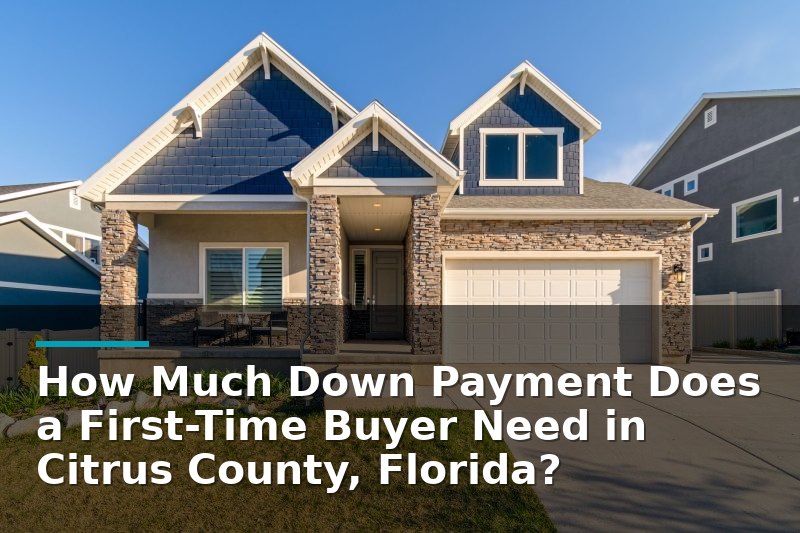
Saving enough cash to buy your first home can feel difficult when you are unsure how much down payment lenders actually require.
A first-time buyer in Citrus County may need as little as 3% down with a qualifying conventional loan, 3.5% with FHA financing, or potentially 0% with an eligible VA or USDA loan.
We will explain the main down payment options, the other funds you may need at closing, and how to build a realistic homebuying budget.
Key Takeaways
- Minimum Down Payment: Qualified buyers may have options ranging from 0% to 3.5% down, depending on the loan program.
- Cash to Close: The down payment is only one part of the total amount needed for closing costs, prepaid expenses, and required reserves.
- Eligibility: Credit, income, debts, occupancy, military eligibility, and property location can affect which programs are available.
- Planning: A pre-approval can help estimate your payment and cash requirement before you make an offer.
Quick Answers About First-Time Buyer Down Payments
- What is the lowest possible down payment? Eligible VA and USDA borrowers may finance a home with 0% down. Some conventional programs begin at 3%, while FHA commonly requires at least 3.5%.
- Do first-time buyers need 20% down? No. Putting 20% down may eliminate private mortgage insurance on a conventional loan, but it is not a general requirement for buying a home.
- Is down payment assistance available? It may be. Assistance programs have separate income, purchase-price, occupancy, education, and funding requirements that must be checked when you apply.
- Is the down payment the only cash needed? Usually not. Buyers should also plan for closing costs, prepaid taxes and insurance, inspections, and possibly financial reserves.
At MSB Home Loans (NMLS# 2166082), we help first-time buyers compare loan programs based on the complete financial picture—not just the advertised minimum down payment. That comparison matters because the option requiring the least cash upfront is not always the option with the most comfortable monthly payment.
Down Payment Requirements by Loan Type
There is no single down payment requirement for every first-time buyer in Citrus County. The minimum depends on the mortgage program, borrower qualifications, property, and lender guidelines.
| Loan Program | Potential Minimum Down Payment | Key Considerations |
|---|---|---|
| Conventional | As little as 3% | Program eligibility, credit, income, occupancy, and mortgage insurance requirements apply. |
| FHA | 3.5% for qualifying borrowers | FHA mortgage insurance and property standards apply. |
| VA | Potentially 0% | Requires qualifying military service, sufficient entitlement, and an eligible property. |
| USDA | Potentially 0% | Household income, property location, occupancy, and program eligibility rules apply. |
These figures are established program minimums, not approval promises. A lender may require a larger investment because of credit history, debt-to-income ratio, property type, loan size, or an individual lender overlay. Guidelines, fees, and market conditions can also change, so current information should be verified before making an offer.
Conventional Loans With 3% Down
Some conventional programs allow qualified buyers to purchase a primary residence with as little as 3% down. These options can work well for borrowers with stable qualifying income and acceptable credit who want a low initial investment.
A down payment below 20% commonly requires private mortgage insurance, or PMI. The cost varies based on factors such as credit, loan-to-value ratio, occupancy, and insurer guidelines. Unlike FHA mortgage insurance, conventional PMI may be removable later if applicable requirements are met.
Not every 3% conventional program has the same definition of a first-time buyer. Some programs require at least one borrower to have had no ownership interest in a principal residence during the applicable lookback period, while other conventional options may not impose that condition. Our first-time home buyer loan overview explains additional factors to consider.
FHA Loans With 3.5% Down
FHA financing generally permits a 3.5% down payment for borrowers who meet the applicable credit and underwriting requirements. FHA loans may offer more flexibility for certain credit profiles, but they include upfront and ongoing mortgage insurance.
FHA also has property requirements. The appraisal evaluates value and checks for conditions that may affect safety, security, or structural soundness. A property that needs significant repairs may require those items to be addressed before closing or may call for a different financing approach.
First-time status is not required for an FHA loan. The home generally must be used as the borrower’s primary residence, and the complete file must meet FHA and lender requirements. Buyers can review the broader FHA home loan program before comparing it with conventional financing.
VA Loans With Potentially No Down Payment
A VA purchase loan may offer 0% down for an eligible borrower with sufficient entitlement. Eligibility generally depends on qualifying military service, but eligibility alone does not establish final loan approval.
The borrower must still meet credit, income, debt, occupancy, and underwriting requirements. The property must also satisfy VA standards. A VA funding fee may apply unless the borrower qualifies for an exemption, and other closing expenses may still require cash even when no down payment is required.
Veterans, active-duty service members, and other potentially eligible borrowers can review the VA purchase loan process for more detail.
USDA Loans With Potentially No Down Payment
USDA financing may provide 0% down when both the borrower and property qualify. USDA eligibility includes household income limits and a property-location test. The home must generally be occupied as the borrower’s primary residence.
Many properties outside dense urban areas may fall within eligible zones, but eligibility should never be assumed from a mailing address alone. Areas around Citrus County, Hernando County, Brooksville, Weeki Wachee, or other nearby communities may contain both eligible and ineligible locations. The exact address must be checked against current USDA data.
USDA financing also includes guarantee fees and underwriting requirements. Our USDA loan overview covers the program’s broader structure.
How Much Is the Down Payment in Dollars?
The basic calculation is straightforward:
Purchase price × down payment percentage = estimated down payment
For example, a 3% down payment on a $250,000 home would be $7,500. A 3.5% down payment on the same purchase price would be $8,750. These examples illustrate the calculation only; they do not include closing costs or establish eligibility for any loan.
A higher purchase price increases the dollar amount needed even when the percentage remains the same. Buyers comparing homes in Homosassa, Crystal River, Inverness, Lecanto, Citrus Hills, or Sugarmill Woods should update the estimate for each price range they are considering.
Down Payment Is Different From Cash to Close
Cash to close is the total amount a buyer must bring to settlement after accounting for the down payment, closing costs, prepaid expenses, deposits, credits, and other adjustments. This number is usually higher than the down payment alone.
Your estimated cash requirement may include:
- The required down payment
- Lender and third-party closing costs
- Prepaid homeowners insurance
- Prepaid property taxes and escrow deposits
- Title-related charges
- Inspection expenses paid before closing
- Flood insurance costs when applicable
- Financial reserves required by the loan program or lender
Florida insurance costs can materially affect affordability. In parts of Citrus County, the property’s flood zone, roof condition, age, construction type, and insurance history may influence the available coverage and premium. We recommend obtaining an insurance estimate early rather than waiting until the final days before closing.
Where Can a First-Time Buyer’s Down Payment Come From?
A down payment does not always have to come entirely from a checking or savings account. Depending on the loan program, acceptable sources may include:
- Verified checking or savings funds
- Eligible gift funds from an acceptable donor
- Proceeds from selling an asset
- Eligible retirement-account withdrawals or loans
- Approved down payment assistance
- Documented grants or employer assistance
Mortgage funds must be properly documented. Large deposits, cash deposits, transfers between accounts, and recently opened accounts may require an explanation and supporting records. Moving money without a clear paper trail can delay underwriting.
Before transferring gift funds or liquidating investments, ask how the transaction should be documented. The correct process varies by program, and selling an investment may create tax consequences that should be discussed with a qualified tax professional.
Can Assistance Cover the Entire Down Payment?
Some assistance programs may cover part or all of a required down payment, and certain programs may also help with eligible closing costs. Availability is not automatic. Programs may have income limits, purchase-price caps, approved-lender requirements, homebuyer education rules, property restrictions, or limited funding.
Assistance may be structured as a grant, a deferred loan, a forgivable loan, or a repayable second mortgage. The repayment terms matter just as much as the amount provided. Some assistance must be repaid when the home is sold, refinanced, or no longer used as a primary residence.
Assistance can also affect the first mortgage’s pricing and monthly payment. We compare the total structure with standard low-down-payment options so the buyer can see both the immediate benefit and the longer-term cost.
How to Choose a Down Payment Amount
The minimum allowed down payment is not necessarily the right amount for every household. A larger down payment may reduce the loan balance, monthly principal and interest, and mortgage insurance cost. It can also leave the buyer with less cash after closing.
We suggest comparing at least three factors:
- Monthly affordability: Review principal, interest, taxes, homeowners insurance, mortgage insurance, association dues, and flood insurance when applicable.
- Post-closing savings: Keep enough accessible money for moving, maintenance, insurance deductibles, and unexpected repairs.
- Total loan structure: Compare interest rate, mortgage insurance, fees, assistance terms, and how long you expect to keep the financing.
Using every available dollar for the down payment may create a lower mortgage balance, but it can also leave too little money for homeownership expenses. A sound plan balances the upfront investment with the need for financial reserves.
Plan Your Citrus County Home Purchase
A useful pre-approval should do more than provide a maximum purchase price. It should show estimated cash to close, monthly housing expense, loan-program tradeoffs, and any documentation that needs attention before an offer is submitted.
We are a small independent mortgage team headquartered in Homosassa, and borrowers work directly with their loan originator rather than a call center. Matt Bouchard has over two decades in the mortgage industry and is a licensed mortgage broker in Florida and Michigan.
If you are considering a home in Citrus County, Hernando County, or Pasco County, we invite you to call, text, or email us. We can review your scenario, compare available options, and help you understand the next steps for pre-approval planning without assuming that the smallest down payment is automatically the right choice.
Frequently Asked Questions
Can gift funds be used for a first-time buyer’s down payment?
Gift funds are commonly allowed under conventional, FHA, VA, and USDA guidelines, but the donor and documentation rules vary. The lender may require a gift letter, evidence of the transfer, and proof that repayment is not expected.
Does buying a manufactured home change the down payment requirement?
It can. The required investment may depend on the home’s age, foundation, title status, land ownership, occupancy, and whether the property meets the selected loan program’s manufactured-housing rules. Lender overlays may also be more restrictive than the underlying agency guidelines.
Can a seller credit pay the buyer’s required down payment?
Seller credits generally cannot replace the borrower’s required minimum down payment. They may be used for eligible closing costs, prepaid expenses, or an approved interest-rate buydown, subject to program limits and the terms of the purchase contract.
Must every borrower be a first-time buyer to use a 3% conventional option?
Not necessarily. Some conventional programs require at least one borrower to meet a first-time buyer definition, while others base eligibility on different criteria. The applicable agency rules and lender overlays should be checked for the specific application.
What happens to the down payment if the appraisal is below the purchase price?
The lender generally calculates the loan using the lower of the purchase price or appraised value, subject to program rules. The buyer and seller may renegotiate, the buyer may cover an approved appraisal gap with additional funds, or the contract may provide other options depending on its terms.
This is educational and not financial advice. Loan programs and guidelines can change. Talk with a licensed mortgage professional about your specific scenario.

About the Author
Matt Bouchard
Mortgage Broker at MSB Home Loans · NMLS #140807
I grew up in a small suburb of Flint, Michigan—the eldest of four kids, raised by a Vietnam veteran dad who worked the line at GM and a stay-at-home mom who kept our busy household running. That blue-collar upbringing taught me the value of hard work, straight talk, and treating people right.
Specializes in: First Time Buyers, Conventional Loans, VA Loans
Licensed in: FL, MI
Related Posts